Three years and four months after Alejandro Oro and Romina Simondi resigned from their well‑paid jobs as accounting experts in Argentina and moved to Spain to boost their son’s chess career, Faustino Oro has inscribed his name in a very special chapter of chess history. He has earned the grandmaster title — more demanding than a black belt in judo — at 12 years, six months, and 26 days. He is the second‑youngest of all time, surpassed only by the U.S. player of Indian descent Abhimanyu Mishra, who set the record by two months.
To become a grandmaster, a player must achieve three highly demanding results — known as norms — in different tournaments, measured by the average strength of their opponents, who must also come from at least three different nationalities. Oro earned his first two norms at the Prodigies and Legends tournament in Madrid last September and at the Szmetan‑Giardelli Masters in Buenos Aires in December. On Sunday, he secured the final one at the Sardinia Open in Italy.
In a paradox of the rating system: his loss to Ian Nepomniachtchi, a two‑time World Championship runner‑up, didn’t matter. The Russian player’s Elo rating was so high (2,729, currently 17th in the world) that it lifted the average strength of Oro’s opponents above the threshold, meaning the title was locked in after eight rounds, once Oro had reached six points, thanks in part to his win the day before against the Pole Niedbała.
“I feel like I already play at a grandmaster level […]. Getting the title is just a matter of time […] I try not to think about it,” Oro told EL PAÍS a month ago, during the live broadcast of the Menorca Chess Open. Now, with that weight finally off his shoulders, his parents’ risky life decision stands vindicated, and he can focus on continuing to improve without any added pressure.
Chess, along with music and mathematics, is one of the activities that produces the most child prodigies. The common factor among all three is abstract thinking. This means that experience — while certainly important — is not as essential as in other fields, such as literature, where no one has ever written like a genius before the age of 15 because doing so requires having lived and read enough beforehand.
In this century, the rise of chess prodigies has accelerated dramatically thanks to training with extremely powerful computers capable of calculating millions of moves per second. This explains why two of the greatest geniuses of all time — the U.S. player Bobby Fischer (1943–2008) and Hungary’s Judit Polgár (1976) — whose achievement of the title at 15 was literally unbelievable in their day, no longer rank among the 50 youngest grandmasters in history. The oldest record among the ten youngest players in history belongs to the Russian of Ukrainian origin, Sergey Karjakin, who won the title in 2002.
Despite that nuance, the trajectory of Oro — who began playing chess during the COVID-19 pandemic — is exceptional even among the youngest prodigies. He is the youngest player in history to earn both the FIDE Master and International Master titles (the two levels below grandmaster). He achieved the latter at 10 years, eight months, and 16 days, surpassing the record previously set by Mishra.
Oro is also the youngest to surpass 2,500 Elo in rapid and blitz, and the youngest ever to play both the World Cup and the final of the Argentine Absolute Championship. In bullet chess (one minute per player for the entire game), Oro defeated Norway’s Magnus Carlsen and the United States’ Hikaru Nakamura — the world No. 1 and No. 3, respectively — in March 2024.
At various points, he has led, often by a wide margin, the world rankings for under‑8, under‑10, under‑11, and under‑12. Right now, he is nearly 100 points ahead of the second‑highest‑rated player born in his year, 2013 — and the same is true if you include those born in 2012. If you extend the group to 2011, only the Turkish phenomenon Yagiz Erdogmus, whom Carlsen has called “the best 14‑year‑old in history,” stands above him, with an astonishing 2,713 Elo (his last game was this loss to Carlsen on Wednesday).
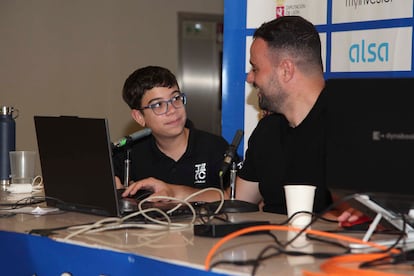
Oro, who still attends school in the Spanish city of Badalona (with a special exam schedule) when he is not playing tournaments, also shone as a live commentator last July at the Magistral Ciudad de León — where he will return next July — after being narrowly eliminated in the semifinals by India’s five‑time world champion Viswanathan Anand.
His poise, naturalness, and extraordinary abilities have not spared him from online haters and conspiracy theorists; for instance, some claimed that the Madrid tournament, where he earned his first norm, was rigged, despite the fact that no one detected the slightest indication of wrongdoing. Carlsen, by contrast, has no doubts about his immense talent: “At 12, Messi didn’t play football as well as Fausti plays chess,” the world No. 1 said after inviting the Argentine to a training session with him in Oslo last January.
Oro, Mishra and Carlsen are the only Western players among the 10 youngest grandmasters in history: 1) Mishra (U.S.), 12 years, four months, 25 days (2021); 2) Oro (Argentina), 12 years, six months, 26 days (2026); 3) Karjakin (Ukraine; now Russia), 12 years, seven months, 0 days (2002); 4) Gukesh (India), 12 years, seven months, 17 days (2019); 5) Erdogmus (Turkey), 12 years, nine months, 29 days (2024); 6) Sindarov (Uzbekistan), 12 years, 10 months, five days (2018); 7) Praggnanandhaa (India), 12 years, 10 months, 13 days (2018); 8) Abdusattorov (Uzbekistan), 13 years, one month, 11 days (2017); 9) Negi (India), 13 years, four months, 22 days (2006); 10) Carlsen (Norway), 13 years, four months, 27 days (2004).
Sign up for our weekly newsletter to get more English-language news coverage from EL PAÍS USA Edition

