People get a lot wrong about Pittsburgh. Its past as a titan of steel, and that industry’s subsequent decline, shaped its reputation as a down-and-out Rust Belt town. This history, though, has contributed to what Pittsburgh is today: a city with a scrappy sensibility, in which world-class art, rich culinary traditions, and welcoming communities have thrived for generations. It’s the birthplace of Andy Warhol, August Wilson, Mister Rogers’ Neighborhood, and, my personal favorite, the Pittsburgh Salad. (Yes, they top salads with french fries here, and yes, it is glorious.) It’s home to the annual furry convention Anthrocon, three beloved black-and-yellow sports teams, Duolingo, and Heinz.
Referred to pejoratively in The Atlantic in 1868 as the “Paris of Appalachia,” Steel City has quietly become an actual cultural capital of its region. Winter—or, as a friend calls it, “the Gray”—may be long and frigid, but by spring, Yinzers (proud Pittsburghers) get amnesia, instantly reveling in the long sunny days as the hillsides erupt in greenery.
In many ways, Pittsburgh’s creative communities now define the city. Artisans are preserving and practicing traditional regional crafts such as glassworks and fiber arts, while chefs are fostering an intriguing culinary identity, with a punk ethos—their risk-taking endeavors finding a game audience. The city serves as a home base for a pilgrimage to an architectural star: Fallingwater.
And there’s a lot of momentum afoot. The Pittsburgh International Airport recently underwent a $1.7 billion transformation. The Smithsonian’s Heinz History Center is set to complete a significant expansion in 2028, including a new interactive exhibition detailing the life and work of hometown icon Fred Rogers.
You can spend years dipping into this city’s many alluring attractions (biking trails, niche subcultures, wooded back streets), as I have since I first started visiting more than a decade ago. But if you only have a long weekend, here’s how to spend it, eating, sightseeing, and dancing your way through Pittsburgh.
Day 1: See Pittsburgh’s history at ground level and its cityscape from above
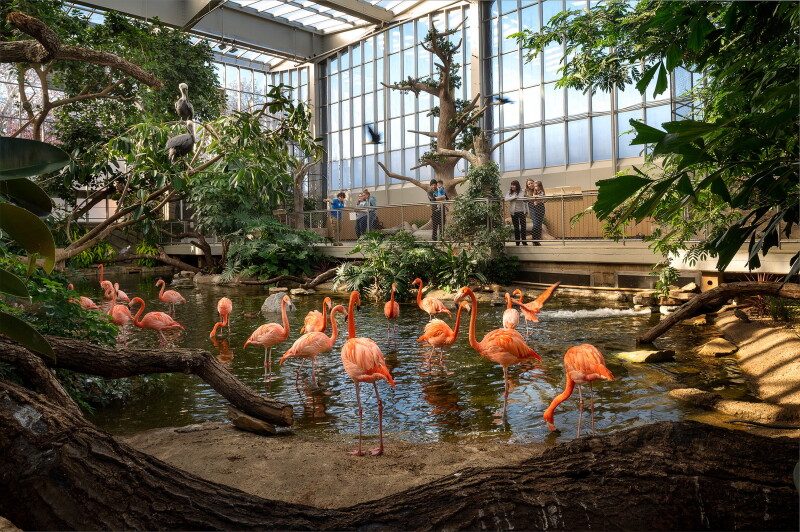
American flamingos are among the 150 species of birds and other animals at the National Aviary.
Sights + activities
Morning: Hit the Strip
Start with the classics. The Strip District is a former industrial neighborhood turned produce and wholesale merchant corridor on Penn Avenue that represents a slice of local history. Businesses such as the butcher shop Strip District Meats and the Italian foods import emporium Pennsylvania Macaroni Co. have been operating there since 1902. But the Strip is also home to a newer cohort of international grocers and specialty shops.
Novaria Coffee is a newcomer, along with a wave of ethnic markets that have made a home in the area in recent decades. While you can get expertly pulled third-wave espresso drinks, consider a Damascus favorite: cardamom-infused qahwa, served in traditional long-handled pots with a small treat (usually date-filled cookies called maamoul). If you’re in the mood and they’re stocked, tack on a za’atar croissant and keep it moving; you’ve got a lot of eating to do on this trip. Walk along Penn Avenue from S&D Polish Deli to Wholey’s Fish Market, pausing to snack on focaccia or cannoli at Colangelo’s Pizza, and make a loop back up Smallman, popping into shops along the way. I’d be remiss not to mention Primanti Bros. on 18th Street. Its sandwiches—stacked heaven-high with meats, cole slaw, and french fries—were invented during the Great Depression to allow truck drivers to eat while on the job, and they remain beloved by many a Yinzer.
Next, head to the South Shore to ride one of two inclines, in operation since the 1870s. (They’re funiculars, but we don’t call them that.) Adult tickets are $5 cash for the century-and-a-half-old Duquesne Incline. At the top, drink in the panorama of Pittsburgh from the Mount Washington observation deck. The Ohio, Allegheny, and Monongahela rivers converge below, with many picturesque bridges arcing in the distance.
Afternoon: Art or the aviary, plus an Appalachian lunch
In the North Side’s Mexican War Streets district, the Mattress Factory is an installation-focused contemporary art museum that founding sculptor Barbara Luderowski described as a place “for artists by artists.” See the rotating suite of works by international and domestic artists, as well as permanent collection pieces by James Turrell, Yayoi Kasuma, and many more.
Prefer animals to art? Check out the nearby National Aviary, the only independent, indoor, nonprofit bird zoo in the United States. In eight immersive habitats, see more than 150 species, from Andean condors to roseate spoonbills, plus a charismatic southern three-banded armadillo named Willy.
A short walk from either institution is Wise County Biscuits. Order the namesake flaky quick bread with whole grain honey mustard butter and salty Broadbent country ham (an Appalachian delicacy), along with cheesy Marsh Hen Mill stone-ground grits. Other enticing menu items: sandwich specials (such as the cornmeal-crusted pork cutlet with cabbage slaw) and the lettuce salad with apple, aged cheddar, fennel, sherry vinaigrette, and savory house-made pecan granola.
Evening: Nordic-style dinner and a show
Head to the Hill District to tour the August Wilson House (AWH), the childhood home of the Pulitzer Prize–winning playwright. Visits are by appointment only, so schedule in advance. If you’re in town in the late summer or early fall, Pittsburgh Playwrights Theatre Company produces Wilson’s works in the AWH backyard. Alternatively, across town in Swissvale, the Carrie Blast Furnaces National Historic Landmark hosts outdoor performances of Shakespeare plays, put on by Quantum Theatre, with the towering steel structure contributing a dramatic backdrop.
Round out the night at the horseshoe bar of the Nordic-ish restaurant Fet-Fisk in Bloomfield, where the red lamplight provides a superior experience compared to the somewhat buttoned-up dining room. The original cocktails are categorized by flavor profile (e.g., bitter, aromatic, sour). I usually go with something from the “classics” section, like the dulse brine dirty martini. Rotating hits from the food menu include pickled mackerel, scallop crudo, and steelhead trout with smoked almond sauce, plus a house marigold schnapps and seasonal panna cotta for your nightcap and dessert.
Day 2: Spend the day in Squirrel Hill and at a world-class museum
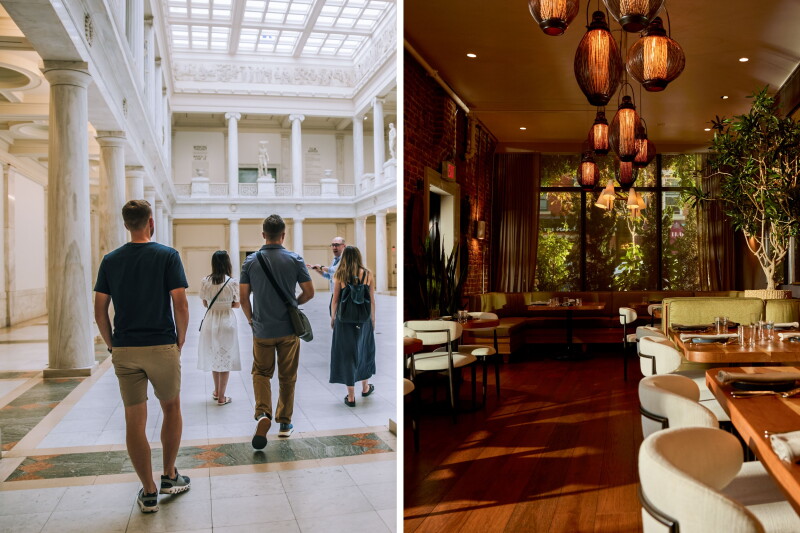
Andrew Carnegie envisioned the Carnegie Museum of Art as collecting works by what he called the “Old Masters of tomorrow”; Pusadee’s Garden serves family-style Thai cuisine in a modern, glass-walled space.
Photo by Julie Kahlbaugh (L); courtesy of Visit Pittsburgh (R)
Sights + activities
Morning: Walk through Mr. Rogers’ (and Annie Dillard and Mac Miller’s) neighborhoods
I don’t wait in lines much these days—but queueing is part of the deal to enjoy what many locals describe as Pittsburgh’s best bagels. The earlier you get to Squirrel Hill and Pigeon Bagels, the better, as it typically sells out by midday. Each ring is baked fresh daily and comes well-speckled with seasonings (if that’s your thing), with a toothsome chew. Add some flaky, buttery rugelach to your bag for a sweet treat.
Squirrel Hill is a historically Jewish enclave and has been home to the Tree of Life Congregation since 1864. (A 2018 mass-shooting attack here made national news, but the synagogue remains a fixture in the community.) It’s also where Fred Rogers resided, and it’s flanked by two impressive green spaces. October, when the trees are golden, is a lovely time to walk some of Frick Park’s 17 miles of trails.
Over the past two decades, an influx of East Asian students at Carnegie Mellon University has nurtured a wellspring of very good Chinese restaurants in the area, including Amazing Dumplings. Each wrapper features bright, painterly swirls, handmade with vegetable dye by co-owner Fenping Geng. Beyond dumplings, the northern Chinese wide biangbiang noodles with chile oil, tomato, and egg have a tingly zip and possibly outshine the house specialty.
Pittsburgh has a number of excellent independent bookstores, but one I bring every visitor to is in Point Breeze, a winsome neighborhood that raised both the late American nonfiction writer Annie Dillard and rapper Mac Miller. Bottom Feeder Books has a deftly curated collection of art tomes and literary first editions, and the shop also functions as a gallery and events space. This is easily one of my favorite places in town: It’s representative of the people of Pittsburgh, who are energized by singular passions and particularities that feel possible to pursue in this city. Buy the book you want, because you likely won’t encounter it again.
If for some reason you’re hungry again, walk around the corner to the bistro Point Brugge for a cocktail and a plate of Belgian-style frites.
Afternoon: Catch the Carnegie International
A year after its 1895 opening, the Carnegie Museum of Art hosted its first major exhibition, spurred by philanthropist, industrialist, and Daddy Warbucks of Pittsburgh, Andrew Carnegie. The Carnegie International has since become the longest running exhibition of international art in North America. The 59th iteration, cocurated by Liz Park, Ryan Inouye, and Danielle A. Jackson, is on display now through January 3, 2027, showcasing painting, photography, sculpture, installation, video, performance, and theater works by 61 artists from around the world.
“Artists from Pittsburgh, Sápmi, Brazil, and beyond bring their perspectives through images, objects, sound, and scent,” Park says. “Working with familiar forms such as gardens, flower arrangements, and comics, they create experiences that range from the miniature to the monumental.”
See this exhibit while you can; the next one is scheduled to debut in 2031.
Evening: Cocktails and khao soi
If you’re a vermouth head, like me, the bar and bottle shop Solera in Upper Lawrenceville is ideal for aperitivo. The Basque-ish small bites, such as salty Gilda skewers, go down easy with a low-ABV spritz, or a Catalonian vermouth, or a glass of dry lambrusco.
A few blocks away, Lawrenceville’s Butler Avenue is where you’ll find some of the city’s finest food and drink options. Book ahead for a table at Pusadee’s Garden, something of a local institution. The Thai restaurant underwent a major renovation in 2017 and now operates across two sleek buildings, a courtyard, and a backyard garden. The richly spiced khao soi, roasted kabocha curry, and crunchy and bright 17-ingredient salad with tamarind dressing are among the standout dishes, as is anything prepared on the rambutan charcoal grill.
Day 3: Take a short road trip to epic architecture
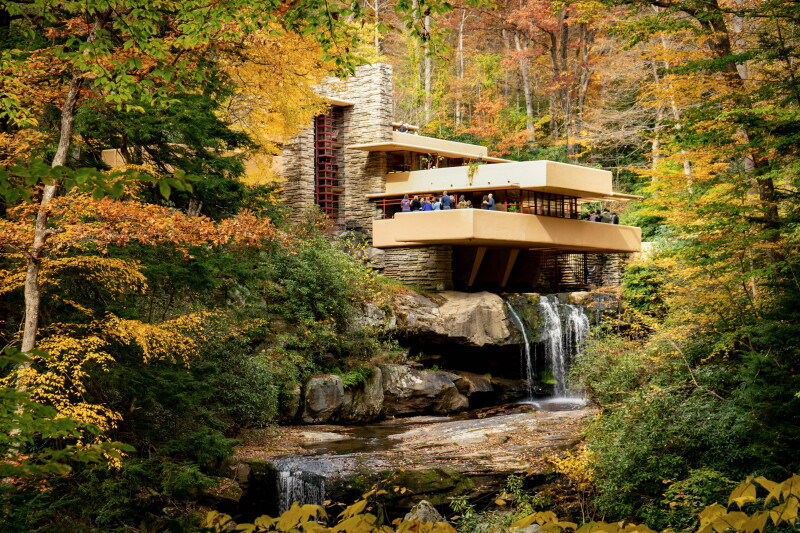
Frank Lloyd Wright designed Fallingwater in the 1930s as a getaway house for the owner of Kaufmann’s Department Store in Pittsburgh.
Photo by Yuhan Du/Unsplash
Sights + activities
Morning: Little Italy pit stop
Today requires a car, so get your hands on a hardbody and stock up on provisions for the road.
Liberty Avenue in Bloomfield is the main corridor of Pittsburgh’s Little Italy. Every Saturday from May to November, purveyors and vendors populate the Bloomfield Saturday Market, as much a community gathering place as an outdoor farmers’ market. Kick off the day with coffee from the Redstart Roasters tent near the entrance. If you’re there on a monthly Forno Brenci day, you’ve hit the baked goods jackpot. Run by chef Daniele Brenci, the Italian bakery sells the best sourdough loaves in town, in addition to a boatload of irresistible pastries.
Buy a couple of sandwiches for the road—my personal favorite, the vegetarian option, is usually some version of potato, wilted spigarello, and Appalachian cheese on flatbread. Now that the stall appears less frequently than it used to, I tack on an enormous chocolate cookie, a babka swirl pastry, and an oat porridge sourdough loaf. There’s always a line, and it moves glacially slow in peak summer, but you won’t regret waiting.
Leave enough time afterward to take a lap. Many of the featured purveyors, including Cold Co. and Chantal’s cheese shop, sell their goods to the best restaurants in the city. Dig in at the picnic tables or nibble on the bits and bobs while en route east.
Afternoon: Frank Lloyd Wright’s Fallingwater
Make the 70-minute drive to Mill Run, where Frank Lloyd Wright’s masterwork, Fallingwater, is set within the woodsy Laurel Highlands region. The UNESCO World Heritage site recently completed a three-year, $7 million restoration. Be sure to purchase tickets in advance, and spring for the In-Depth Guided Tour, which permits visitors extended access to the cantilevered home, designed in 1935 to sit above a waterfall. The docents are deeply knowledgeable, offering insights about Wright’s organic architecture principles and pointing out details such as how the all-glass corner study windows let the sound of the Bear Run stream flow indoors. Admire the original furnishings and design elements that remain meticulously preserved, including a fireplace with a crane-arm kettle in the sunken living room.
If you’re in the mood for more nature immersion, Ohiopyle State Park, chock full of waterfalls, trails, and swimming holes, is 3.5 miles away. If you’re feeling peckish on the way back to Pittsburgh, have lunch in one of the bungalows at TreeTops Restaurant in Polymath Park, an architecture resort 23 miles north of Fallingwater containing four historic houses. Take a tour detailing the park’s two Frank Lloyd Wright creations—the Duncan House and Mäntylä—plus the Balter and Blum Houses by apprentice Peter Berndtson. (You can even stay overnight in one of these rentable time capsules.)
Evening: Dinner at the best new restaurant in Pittsburgh
After driving back into town, take a dusk walk in Lawrenceville’s Allegheny Cemetery. Beyond being a place of remembrance, the 100-acre landmark functions as a nature reserve of sorts, where you can spot deer, rabbits, foxes, and groundhogs. It also offers a peek into handicrafts history: For almost 200 years, Pittsburgh was known not just as Steel City but also Glass City, initially for its industrial glassmaking and later for its studio arts and crafts traditions, which are reflected in the ornate mausoleums in varying architectural styles, from art deco to Egyptian inspired. Beyond the decorative stone trim or patinated bronze doors are stained-glass scenes of sherbet sunsets and elaborate landscapes, plus swirled panels reminiscent of iridescent abalone shells.
A short stroll from the cemetery is Titusz, an ode to chef-owner Csilla Thackray’s Hungarian heritage and hands-down the best restaurant in the city right now. (The New York Times says it’s one of the top 50 restaurants in the country.) The menu strikes a balance of modern-classic interpretations, seasonal riffs, skillful sauces, and refined flavors. Order everything from the top sections, plus a main dish. Standouts include the langos (a surprisingly light fried potato pancake topped with soft cheeses and herb salad), the kaspressknödel (delicate dumplings in a leek and sauerkraut broth), and the seasonal fish (such as walleye with fennel and celeriac).
The space is a mix of vintage decor and custom Pittsburgh-made designs, including wallpaper by Otea Textiles and a fetching handmade bench by Bones & All. Cocktails are focused and inventive but without pretension, while the wine list is extensive and playful, traversing Austria and Hungary. Service is knowledgeable, warm, and the right amount of attentive.
Day 4: Tour art houses and boogie down at a brewery
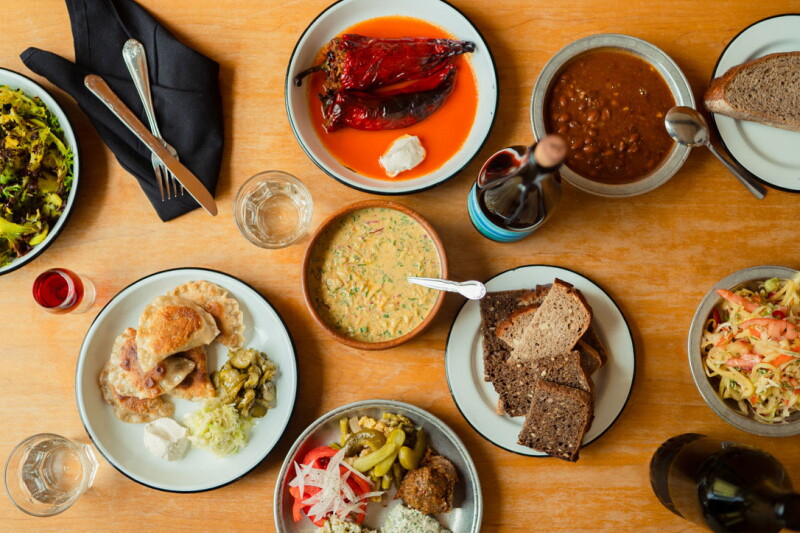
Apteka specializes in vegan versions of pierogies, borscht, and other Eastern and Central European dishes.
Sights + activities
Morning: Art houses in Troy Hill
Spend the first part of the day in the riverside neighborhood of Troy Hill. Start with a breakfast sandwich at Scratch & Co., which sources 90 percent of its ingredients from local farms. (You’ll have to return for dinner, when the restaurant serves a creation that has developed a cult following: the Pecorino-fried chicken sandwich with tahini buffalo sauce.)
Among the lesser known treasures in the city (even to many long-time Pittsburghers) are the Troy Hill Art Houses. Inspired by Japan’s art island, Naoshima, local collector Evan Mirapaul commissioned artists to reimagine four formerly abandoned buildings as site-specific art experiences. Each one—Thorsten Brinkmann’s La Hütte Royal, Robert Kusmirowski’s Kunz House, Lenka Clayton and Phillip Andrew Lewis’s Darkhouse Lighthouse, and Mark Dion’s Mrs. Christopher’s House—is a cabinet of curiosities that’s impressive in scale, concept, and execution. A fifth property has been procured, a docent told me, with a long runway of planning in the works.
I’m not getting into specifics here because I recommend what a friend told me: Don’t read or watch anything about the exhibits; just show up and let the surprises unfold. Tours are by appointment only (each house tour takes about an hour) and led by knowledgeable guides. La Hütte Royal and Mrs. Christopher’s House are open Thursdays and weekends, while viewings of the Kunz House and the not-to-be-missed Darkhouse Lighthouse are available on Saturdays and Sundays only.
Afterward, pop into the Troy Hill outpost of the employee- and family-owned De Fer Coffee & Tea for a midday pick-me-up. The roaster serves ethically sourced coffee at six locations across the city.
Afternoon: Get groovy at the Disco
The summertime Disco Sunday Disco at Trace Brewing in Bloomfield is a series of sunny dance parties from 3 to 9 p.m. DJs spin classic ’70s bops and deep cuts on vinyl. The energy is euphoric, queer, and welcoming, with festivities spilling from the bar courtyard to the adjacent alley. The space, a former brass and bronze foundry, is also a café during the day, with an outdoor biergarten as well as a midcentury-modern wood-burning fireplace indoors for chillier nights.
Evening: Pierogies and plant-based Eastern European food
Lawrenceville’s Apteka is an anomaly: a counter-service vegan restaurant and bar that’s packed every night. The menu focuses on plant-based twists of Central and Eastern European classics, such as the lokša, a Slovak potato flatbread with smoked beans and roasted corno peppers. Pierogies—a Pittsburgh staple, thanks to the city’s Polish immigrant history—are tasty here as well, with unique fillings like smoked carrot.
Aside from regular dinner service, there are several themed nights, such as Crapteka (an occasional fast-food menu takeover), Vintoteka (Thursday wine bar nights), and Lonely No More (ambient-ish DJ sets from 9 to 11 p.m. on Sundays).
Round out the meal—and your trip—with Apteka’s housemade cordials (the tart cherry or the mulberry are delightful) and seasonal sweets like the autumnal apple cake with black currant jam and anise hyssop sugar.

Where to stay: Pittsburgh hotels
The 2020 shuttering of the Ace Hotel in East Liberty left something of a gap in vibey accommodations. Several projects are scheduled to be completed in the next few years, notably the Hotel Bardo in the Gulf Tower downtown and the much-anticipated rebirth of Nied’s Hotel—a beloved Lawrenceville fish sandwich haven and inn, currently in renovations under new owners, including Tom Barr and Leigh Yock of the popular rooftop bar, pizzeria, and music venue Spirit. In the meantime, our top pick for this itinerary would be:
The newest accommodation in town is the Atterbury Hotel, which opened in June 2026. Following a multimillion-dollar renovation, the property—named for Grosvenor Atterbury, who in 1906 designed the original 13-story building—now has 300 updated rooms and suites and a gastrobar, the Drafting Room.

