By Joel O’Leary for Motley Fool Money

Picture a family of four booking a winter holiday vacation in Montana. At roughly $695 per traveler for airfare, hotel, and rental car, that’s about $2,780 before any day-to-day expenses kick in. That’s according to a Motley Fool Money estimate of holiday travel costs based on industry data.
Putting that on a credit card for travel comes with some built-in perks. You can earn rewards, maybe snag a $300+ welcome offer, and some travel rewards cards even include trip insurance if plans go sideways (when do they not during the Christmas rush?).
Motley Fool Money shares what to know before you swipe for your upcoming trip.
AAA projected that nearly 118 million Americans would drive or fly for the 2025 year-end holidays. That’s a lot of people who could optimize credit card rewards, save with perks, and put cash back in their pockets after an expensive trip.
If you’re flying, a top travel rewards card is the best way to earn extra on airfare and hotels. If you’re driving, gas and grocery credit cards earn more on fill-ups and road-trip snacks.
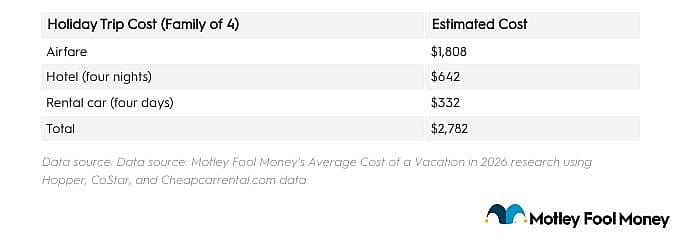
For families flying across several states, the airfare is just the start. Here’s roughly what that Montana trip looks like with a hotel and rental car included, based on Motley Fool Money’s analysis of travel industry data.
Folks with family in reasonable driving range get a big break. A 1,000-mile drive costs about $155 in gas, based on AAA’s national average and a car that gets 28 mpg. That’s where a gas card earns its keep.
Americans earned about $47 billion in credit card rewards in 2024, according to credit card rewards statistics compiled by Motley Fool Money from CFPB data.
Of course, some travelers skip the hotel line entirely by staying with the in-laws. That can save $642 on a trip. It won’t, however, save anyone from the 6 a.m. kitchen standoff with a father-in-law who drinks his coffee in total silence and expects the same from everyone else.
Saved credit card points can cover part of a holiday flight
The points sitting in your account right now might knock a real chunk off your trip cost.
The average credit card rewards balance was $192 at the end of 2024, according to the CFPB. That’s less than half of a $402 Thanksgiving fare, but it’s still money you don’t have to find somewhere else.
The bigger risk is letting those points disappear. About 2.8% of credit card accounts forfeited at least some rewards in the fourth quarter of 2024, per the CFPB, and of the $47 billion in rewards Americans earned in 2024, about $6.6 billion were miles. Log in and check your balance before you book, especially if a card has been sitting in a drawer.
Picture a traveler who finds $150 in forgotten points the night before booking. That covers the checked bags for the whole family, or most of a rental car day. A little time spent redeeming points strategically can stretch them even further.
If airfare is expensive enough, consider a travel card with a welcome offer
A new travel card’s welcome offer can cover most of one holiday flight on its own.
The average credit card welcome offer was worth $311 in 2024, according to the CFPB. That’s about 69% to 77% of one traveler’s holiday fare.
There’s a catch to earning credit card sign-up bonuses, though. Most issuers require you to spend a set amount within a few months of opening the card. For example, spending $1,000 on the card within the first 90 days.
A holiday trip you were booking anyway can get you there fast, since a single round of family flights can cover much of a typical spending requirement.
A $1,500-plus trip is one credit card statement, so the payoff plan matters
As long as you pay your full statement balance by the due date, you won’t owe a dime of interest. If you miss that, any rewards you earn get eaten away.
Here’s the math. Let’s say you carry a $1,500 trip balance at 22% APR and pay $100 a month towards it. You’ll spend about 18 months paying it off, while handing over roughly $270 in interest.
If paying in full isn’t realistic, 0% intro APR cards can spread the cost over time without interest. Just make sure to split the balance evenly across the promo window so your balance is cleared before the regular APR applies. On a 12-month window, that $1,500 trip works out to payments of $125 a month.
A big credit card charge and a new account both show up on a credit score
Payment history makes up 35% of a FICO® Score, amounts owed 30%, and new credit 10%, according to FICO. Booking a big trip on a new credit card can move all of these numbers.
That middle number is where a big trip can sting. Say that $2,782 Montana trip lands on a card with a $5,000 limit. That’s 56% of the limit in use, and scoring models see a high share like that as a sign of financial stress, even if the family pays it off in full a few weeks later.
The fix is all about timing. Card issuers usually report your balance to the credit bureaus when your statement closes, so paying the trip off before that date keeps the reported number low. Opening a new card counts as new credit too, and it can cause a small, temporary dip.
A temporary dip in credit score rarely matters for most people. If you’re about to apply for a mortgage or car loan, though, it’s smart to hold off on new credit cards until that’s done.
The best holiday trips end with memories, not a balance
The holidays are expensive, emotional, and a little chaotic, and your credit card shouldn’t add to the stress. It should actually remove some of it, with rewards and perks.
Just pick the right rewards credit card for your travel type, use the points you’ve already earned, and have a plan to pay it off before January’s bill lands.
Take that family flying to Montana. With the right card and a payoff plan, they come home with rewards in the bank, photos of the kids in the snow, and maybe one more silent cup of coffee with the father-in-law.
FAQs
Does my credit card have travel insurance?
Some credit cards include travel insurance, but many don’t. Cards with coverage usually require you to pay for the trip with that card. Check your card’s benefits guide for trip cancellation, delay, and lost baggage coverage before you book.
Is it better to pay for flights with a credit card or debit card?
A credit card is usually the better choice for booking flights. Federal law gives credit cards stronger fraud and dispute protections, and the charge doesn’t pull cash from your checking account right away. Many cards also earn higher rewards on airfare.
Can I use my credit card points to book a flight for someone else?
Yes, most rewards programs let you book flights for family or friends with your points. Some programs limit point transfers to authorized users or household members, so check the rules before booking a big family trip.
This story was produced by Motley Fool Money and reviewed and distributed by Stacker.
Picture a family of four booking a winter holiday vacation in Montana. At roughly $695 per traveler for airfare, hotel, and rental car, that’s about $2,780 before any day-to-day expenses kick in. That’s according to a Motley Fool Money estimate of holiday travel costs based on industry data.
Putting that on a credit card for travel comes with some built-in perks. You can earn rewards, maybe snag a $300+ welcome offer, and some travel rewards cards even include trip insurance if plans go sideways (when do they not during the Christmas rush?).
Motley Fool Money shares what to know before you swipe for your upcoming trip.
A credit card for travel earns rewards on flights, and a gas credit card can help cover the drive
AAA projected that nearly 118 million Americans would drive or fly for the 2025 year-end holidays. That’s a lot of people who could optimize credit card rewards, save with perks, and put cash back in their pockets after an expensive trip.
If you’re flying, a top travel rewards card is the best way to earn extra on airfare and hotels. If you’re driving, gas and grocery credit cards earn more on fill-ups and road-trip snacks.
For families flying across several states, the airfare is just the start. Here’s roughly what that Montana trip looks like with a hotel and rental car included, based on Motley Fool Money’s analysis of travel industry data.
Folks with family in reasonable driving range get a big break. A 1,000-mile drive costs about $155 in gas, based on AAA’s national average and a car that gets 28 mpg. That’s where a gas card earns its keep.
Americans earned about $47 billion in credit card rewards in 2024, according to credit card rewards statistics compiled by Motley Fool Money from CFPB data.
Of course, some travelers skip the hotel line entirely by staying with the in-laws. That can save $642 on a trip. It won’t, however, save anyone from the 6 a.m. kitchen standoff with a father-in-law who drinks his coffee in total silence and expects the same from everyone else.
Saved credit card points can cover part of a holiday flight
The points sitting in your account right now might knock a real chunk off your trip cost.
The average credit card rewards balance was $192 at the end of 2024, according to the CFPB. That’s less than half of a $402 Thanksgiving fare, but it’s still money you don’t have to find somewhere else.
The bigger risk is letting those points disappear. About 2.8% of credit card accounts forfeited at least some rewards in the fourth quarter of 2024, per the CFPB, and of the $47 billion in rewards Americans earned in 2024, about $6.6 billion were miles. Log in and check your balance before you book, especially if a card has been sitting in a drawer.
Picture a traveler who finds $150 in forgotten points the night before booking. That covers the checked bags for the whole family, or most of a rental car day. A little time spent redeeming points strategically can stretch them even further.
If airfare is expensive enough, consider a travel card with a welcome offer
A new travel card’s welcome offer can cover most of one holiday flight on its own.
The average credit card welcome offer was worth $311 in 2024, according to the CFPB. That’s about 69% to 77% of one traveler’s holiday fare.
There’s a catch to earning credit card sign-up bonuses, though. Most issuers require you to spend a set amount within a few months of opening the card. For example, spending $1,000 on the card within the first 90 days.
A holiday trip you were booking anyway can get you there fast, since a single round of family flights can cover much of a typical spending requirement.
A $1,500-plus trip is one credit card statement, so the payoff plan matters
As long as you pay your full statement balance by the due date, you won’t owe a dime of interest. If you miss that, any rewards you earn get eaten away.
Here’s the math. Let’s say you carry a $1,500 trip balance at 22% APR and pay $100 a month towards it. You’ll spend about 18 months paying it off, while handing over roughly $270 in interest.
If paying in full isn’t realistic, 0% intro APR cards can spread the cost over time without interest. Just make sure to split the balance evenly across the promo window so your balance is cleared before the regular APR applies. On a 12-month window, that $1,500 trip works out to payments of $125 a month.
A big credit card charge and a new account both show up on a credit score
Payment history makes up 35% of a FICO® Score, amounts owed 30%, and new credit 10%, according to FICO. Booking a big trip on a new credit card can move all of these numbers.
That middle number is where a big trip can sting. Say that $2,782 Montana trip lands on a card with a $5,000 limit. That’s 56% of the limit in use, and scoring models see a high share like that as a sign of financial stress, even if the family pays it off in full a few weeks later.
The fix is all about timing. Card issuers usually report your balance to the credit bureaus when your statement closes, so paying the trip off before that date keeps the reported number low. Opening a new card counts as new credit too, and it can cause a small, temporary dip.
A temporary dip in credit score rarely matters for most people. If you’re about to apply for a mortgage or car loan, though, it’s smart to hold off on new credit cards until that’s done.
The best holiday trips end with memories, not a balance
The holidays are expensive, emotional, and a little chaotic, and your credit card shouldn’t add to the stress. It should actually remove some of it, with rewards and perks.
Just pick the right rewards credit card for your travel type, use the points you’ve already earned, and have a plan to pay it off before January’s bill lands.
Take that family flying to Montana. With the right card and a payoff plan, they come home with rewards in the bank, photos of the kids in the snow, and maybe one more silent cup of coffee with the father-in-law.
FAQs
Does my credit card have travel insurance?
Some credit cards include travel insurance, but many don’t. Cards with coverage usually require you to pay for the trip with that card. Check your card’s benefits guide for trip cancellation, delay, and lost baggage coverage before you book.
Is it better to pay for flights with a credit card or debit card?
A credit card is usually the better choice for booking flights. Federal law gives credit cards stronger fraud and dispute protections, and the charge doesn’t pull cash from your checking account right away. Many cards also earn higher rewards on airfare.
Can I use my credit card points to book a flight for someone else?
Yes, most rewards programs let you book flights for family or friends with your points. Some programs limit point transfers to authorized users or household members, so check the rules before booking a big family trip.
This story was produced by Motley Fool Money and reviewed and distributed by Stacker.

